
Introduction
If you’ve just opened an account at a bank or received your first paycheck, the first big question is usually: where to put the money? There isn’t a one‑size‑fits‑all answer. In 2026, the two most talked‑about categories are fixed income and variable income. Each has its own advantages, risks, and ideal moments to use. In this article we’ll look at both sides of the coin, compare the key criteria, and help you decide which matches your goal, risk tolerance, and time horizon. Oh, and at the end we’ll point you to a handy tool – FinMoovi – that makes tracking any choice you make a breeze.
How Fixed Income Works
Fixed income includes investments where the remuneration (interest or yield) is already pre‑defined or has a maximum limit. The investor knows, at the moment of application, what the return rate will be or, at the very least, the range of variation. The main products are:
| Product | Where to Find | Average Rate 2024‑2025* | Features |
|---|---|---|---|
| CDB (Bank Deposit Certificate) | Commercial banks | 108 % of CDI (≈ 13.2% a year) | FGC guarantee up to R$ 250 k per institution |
| Treasury Direct – Selic | Federal government | 12.8 % a year (Selic 2026) | Daily liquidity, low sovereign risk |
| LCIs/LCAs (Real Estate/Agricultural Credit Letters) | Banks, brokerages | 107 % of CDI (≈ 13 % a year) | IR‑exempt, FGC protection |
| Corporate Debentures | Brokerages | 9 %‑12 % a year (depending on rating) | Credit risk of the issuing company |
*Rates based on data from the Central Bank and Treasury Direct up to December 2025.
The logic is simple: you lend money (or buy bonds) and receive interest over time. The principal (the amount invested) is usually returned at maturity or can be redeemed early, depending on the product. Because the remuneration is linked to indexes like the CDI or Selic, changes in the country’s interest rates affect the return directly.
Advantages of Fixed Income
- Predictability – You know how much you’ll earn, or at least you have a guaranteed floor.
- Low risk of capital loss – In most cases, risk is limited to the issuer (bank or government).
- Liquidity – Selic Treasury and some CDBs allow redemption at any time without a heavy penalty.
- IR exemption – LCIs and LCAs are tax‑free, which boosts net yield.
Disadvantages of Fixed Income
- Limited profitability – When inflation rises, fixed income can fall behind more aggressive investments.
- Dependence on the Selic rate – If the Central Bank keeps rates low for a long period, returns drop.
- Possible “opportunity cost” – Money locked in a 5‑year CDB earns less than stocks that could jump 30 % in six months.
How Variable Income Works
Variable income gathers assets whose return is not guaranteed and depends on market performance. The main categories are:
| Product | Where to Find | Average Return 2024‑2025* | Features |
|---|---|---|---|
| Listed company stocks | Stock exchange (B3) | 12 %‑20 % a year (Ibovespa index) | High volatility, occasional dividends |
| ETFs (Index Funds) | Brokerages | 11 %‑18 % a year (e.g., BOVA11) | Automatic diversification, low management fee |
| Real Estate Investment Funds (FIIs) | Brokerages | 7 %‑9 % a year (monthly yield) | Rental income, vacancy risk |
| Cryptocurrencies | Exchanges | Varies widely (e.g., BTC 2024: +30 % a year) | Extremely volatile, regulatory risk |
*Return based on historical performance of the Ibovespa and main ETFs up to December 2025.
In practice, when you buy a stock you become a shareholder of the company. Your gain comes from share price appreciation (when the price goes up) and, sometimes, from dividends paid out. The return can far exceed that of fixed income, but it can also be negative during downturns.
Advantages of Variable Income
- High return potential – In growth cycles, stocks can multiply capital.
- Diversified income sources – Dividends, interest on equity, capital gains.
- Inflation protection – Companies can adjust prices, preserving purchasing power.
- Flexibility – You can build portfolios by sector, theme (tech, clean energy) or risk level.
Disadvantages of Variable Income
- Volatility – Daily swings can cause fear and hasty decisions.
- Risk of total loss – Companies can go bankrupt, shares can become worthless.
- Need for monitoring – Requires study, news reading, and sometimes technical analysis.
- More complex taxes – Capital gains taxed at 15 % (for stocks) and 20 % (for other assets).
Comparative Table
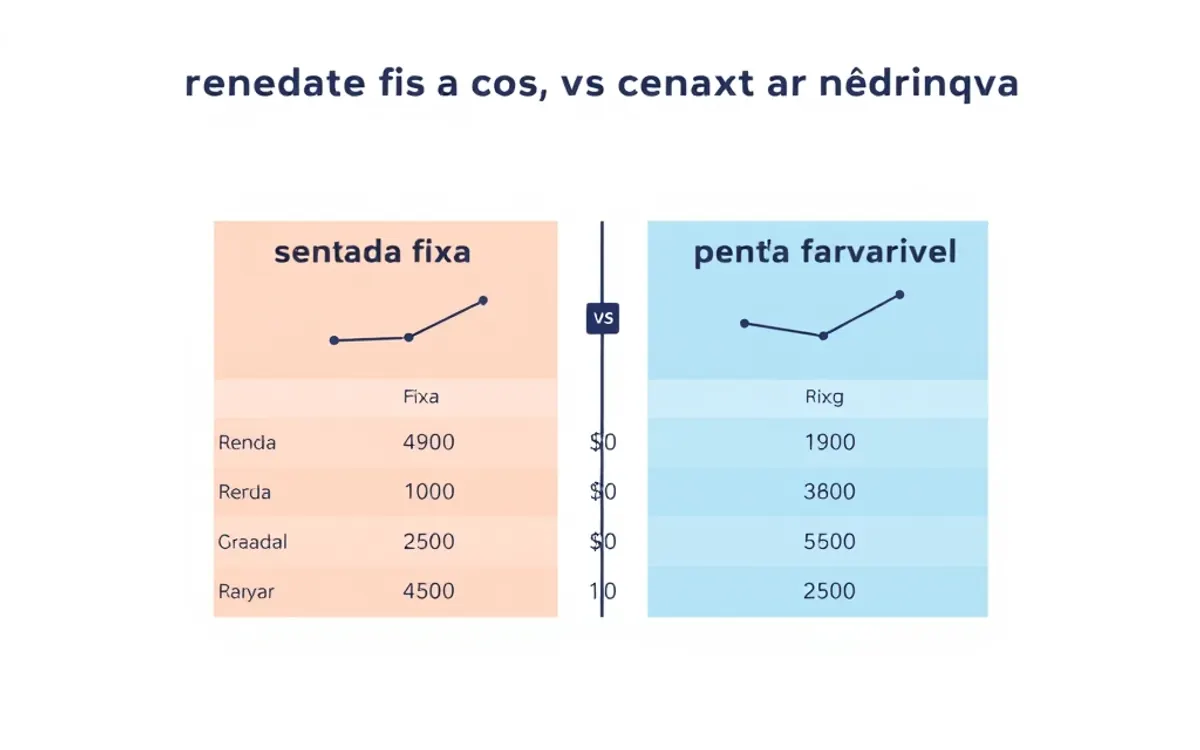
| Criterion | Fixed Income | Variable Income |
|---|---|---|
| Return predictability | High (pre‑defined rates) | Low (market‑dependent) |
| Capital loss risk | Low to moderate (FGC, sovereign risk) | High to moderate (company, sector) |
| Liquidity | Generally high (Selic Treasury, CDBs) | Varies (stocks can be highly liquid, FIIs less) |
| Average return (2024‑2025) | 12 %‑13 % a year (CDI, Selic) | 12 %‑20 % a year (Ibovespa, ETFs) |
| Inflation protection | Moderate (depends on index) | Good (companies can pass inflation on) |
| Tax implication | Regressive IR (15 %‑22.5 %) or exempt (LCI/LCA) | IR of 15 % (stocks) or 20 % (others) |
| Management complexity | Simple (just pick the bond) | More complex (market analysis) |
| Suitable for | Conservatives, short/medium term, emergency reserve | Aggressive, medium/long term, growth seekers |
| Product example | Selic Treasury 2026 (12.8 % a year) | BOVA11 ETF (Ibovespa) – 15 % a year |
When to Choose Fixed Income
- Short‑term goal – If you need the money within up to 2 years (e.g., emergency fund, vacation), fixed income ensures the capital stays preserved.
- Conservative profile – Those who can’t tolerate seeing their investment value swing prefer the safety of a CDB or Treasury.
- High‑interest environment – When the Selic is above 12 % a year, fixed income already offers very attractive returns.
- Need for income – LCIs/LCAs and some debentures pay monthly interest, generating a stable cash flow.
Practical Strategy
- 30 % of assets in Selic Treasury for immediate liquidity.
- 30 % in CDBs maturing in 2‑3 years, taking advantage of the CDI rate.
- 20 % in LCIs/LCAs for IR exemption.
- 20 % in corporate debentures from well‑rated companies (AA rating or higher).
When to Choose Variable Income
- Long‑term horizon – If you have 5 years or more and can “ride out” volatility, variable income can comfortably outpace inflation.
- Aggressive profile – Those who can tolerate up to a 30 % capital drop in a year but aim for 20 %‑30 % annual returns have room for stocks and ETFs.
- Seeking diversification – Investing across different sectors (technology, clean energy) or FIIs can lower relative risk.
- Low‑interest scenario – When the Selic is at historically low levels (e.g., 6 % a year), fixed income loses appeal and variable income becomes more interesting.

Practical Strategy
- 40 % in broad‑market ETFs (e.g., BOVA11) for diversification without picking individual stocks.
- 30 % in dividend‑paying stocks (e.g., banks, utilities) to generate passive income.
- 20 % in FIIs that pay monthly yields.
- 10 % in short‑term opportunities (e.g., small‑caps or cryptocurrencies) – only if you have sufficient knowledge.
Verdict
There is no absolute “best”; the choice depends on your profile, timeline, and goal. If you’re still building the habit of saving, fear seeing your money “disappear,” and need liquidity, fixed income should be the foundation of your portfolio. It protects your capital, offers stable returns, and still allows you to build an emergency reserve.
On the other hand, if you have plenty of time, can handle the market’s roller‑coaster, and want returns that comfortably beat inflation, variable income can be the main growth lever. The most balanced recommendation is usually to mix both worlds: keep a safe slice (fixed income) and allocate the rest to higher‑return opportunities (variable income).
Regardless of the choice, management and monitoring are essential. That’s where FinMoovi comes in as your ally: the app lets you log each investment, track performance in real time, set short‑ and long‑term goals, and receive alerts when your allocation drifts off plan. That way, you stay in control without needing to be a market analyst.
Practical tip: Start with 70 % in fixed income and 30 % in variable income. As you gain confidence and observe volatility, adjust the proportion until you find the sweet spot between safety and upside potential.



Comentários
Comentários via GitHub Discussions. Faça login com sua conta GitHub para participar.